The bike, the conveyor chain, and the Friday evening call
A computer-vision project that began with a bicycle chain, became a patented industrial monitoring system, and taught me what it takes to stay with a difficult problem.

Perhaps the biggest project I have worked on so far started somewhere completely different.
It started with a time-series analysis problem around electric conveyor drives. After a couple of months, we presented our work to an assembly plant. The engineering manager was honest: the drives were not their biggest concern. But there was another problem. Every so often, a failure in a long conveyor chain could cause unplanned downtime, and finding the exact place that needed attention was not quick.
That was the real problem.
Start with a smaller problem
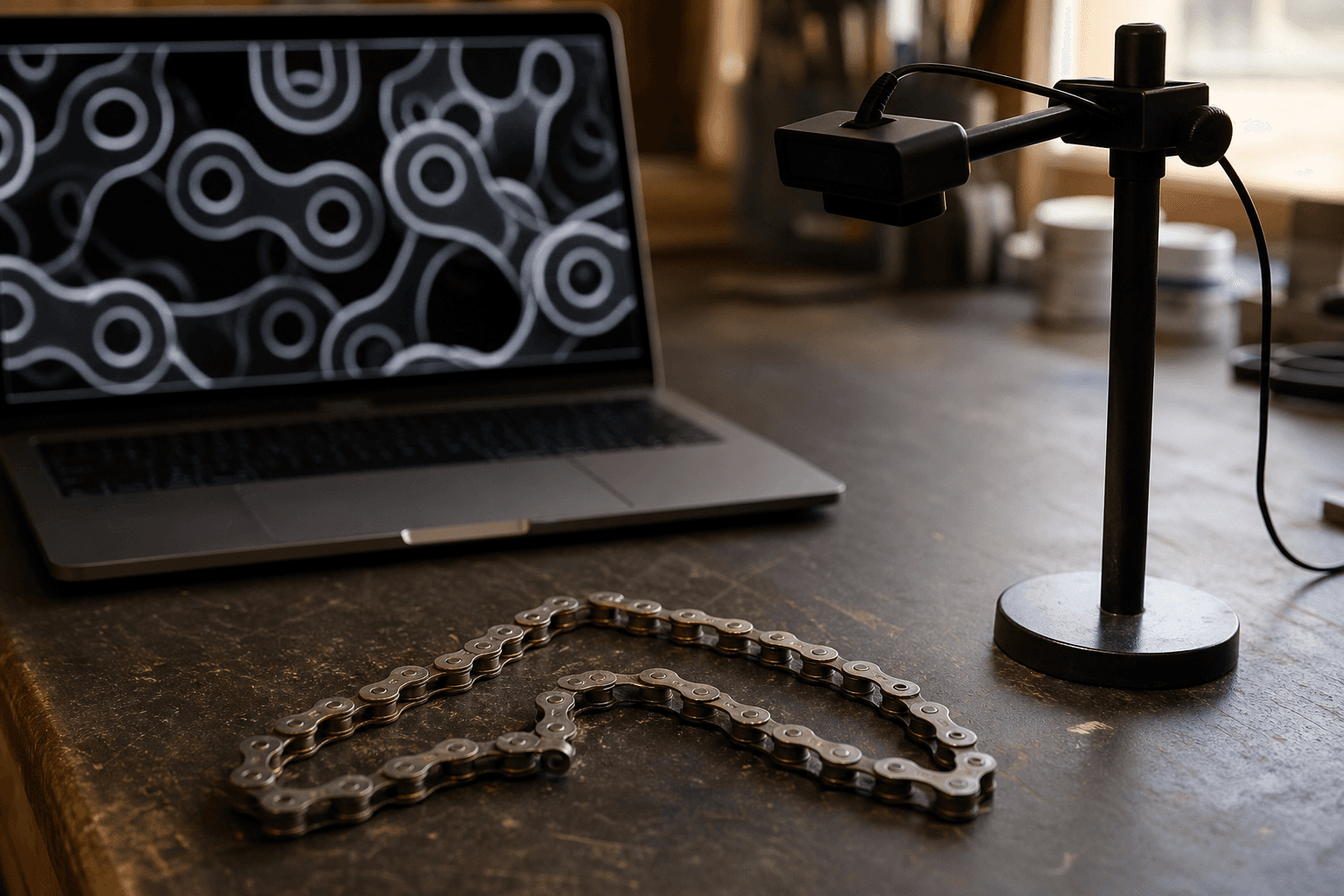
We got to work on using computer vision to monitor the chain. The first version of the problem had to be smaller, literally, so we started with a bicycle chain. I used OpenCV to find simple shapes, locate links, follow their movement through the frame, and measure the gaps between them. It worked well enough to prove that we had a path forward.
A small side story: I had a stock photo of a Cadillac as my wallpaper. Whenever I shared my screen, someone on the team would ask, "Is that your Cadillac?" Just as I was about to say, "Yeah, someday," another voice said, "No, that's his bike in the back." The bike was locked to a street lamp in the photo, and the team would not let it go. I changed the wallpaper, and they asked whether I had sold my bike.
Anyway, the real chain was much harder.
The part where nobody had the answer
For weeks, we collected video, preprocessed it, built detection components, analysed what we were seeing, and kept throwing ideas at the wall. The development team and our project lead met twice a week to work through it. Some meetings ended in total silence. Everyone had an idea, then disproved it in their own head before saying it out loud.
It was not glamorous, but we kept going.
Then one day, it clicked. Looking at the chain from the right angle, the visible profile changed from link to link. That observation gave us a way to distinguish patterns in a moving chain. Great, but then came the next problem: how do you keep track of individual links? They all look the same, and they run in a loop! From there, the problem became less about spotting a single fault in a single frame and more about building a reliable reference for the chain as it cycled.
What I can share
The system later became the subject of a patent assigned to GM Global Technology Operations LLC. I am one of the named inventors. The public patent describes the broad approach: fixed-camera imaging, high-contrast processing, matching observed link profiles against predefined templates, and using the sequence of links to build a chain fingerprint. I am deliberately keeping the implementation details and internal operating results out of this post.

The Friday evening call
One Friday evening, while going through a large set of chain footage, I noticed a missing component appearing again and again at a regular interval. I called the project lead straight away: "I found something." He dropped what he was doing, joined the call, and we worked out when it should come back into view. The engineering manager at the plant had enough notice to find it during a planned break.
The following week, we received a thank-you email from the plant. They had dealt with the issue during scheduled downtime instead of discovering it after a failure.
That moment stays with me. A lot of the work before it felt like slow, uncertain progress: video after video, failed idea after failed idea, and meetings where nobody had the answer yet. Then a small observation became useful at the exact moment it needed to be.
What stayed with me
The project grew well beyond that first fault-detection problem, but I am proudest of the way the team worked. We stayed with a difficult problem long enough to understand it, trusted each other enough to challenge weak ideas, and earned trust from the people who had to use the result in the real world.
I learned a lot from this project: technically, of course, but also about troubleshooting, collaboration, and how much client trust matters. I am grateful to the leadership team and to the teammates who worked through it with me.
Patent reference: US 11,798,158 B2, "Systems and methods for monitoring chain health" (issued 24 October 2023; published application: US 2023/0153985 A1).